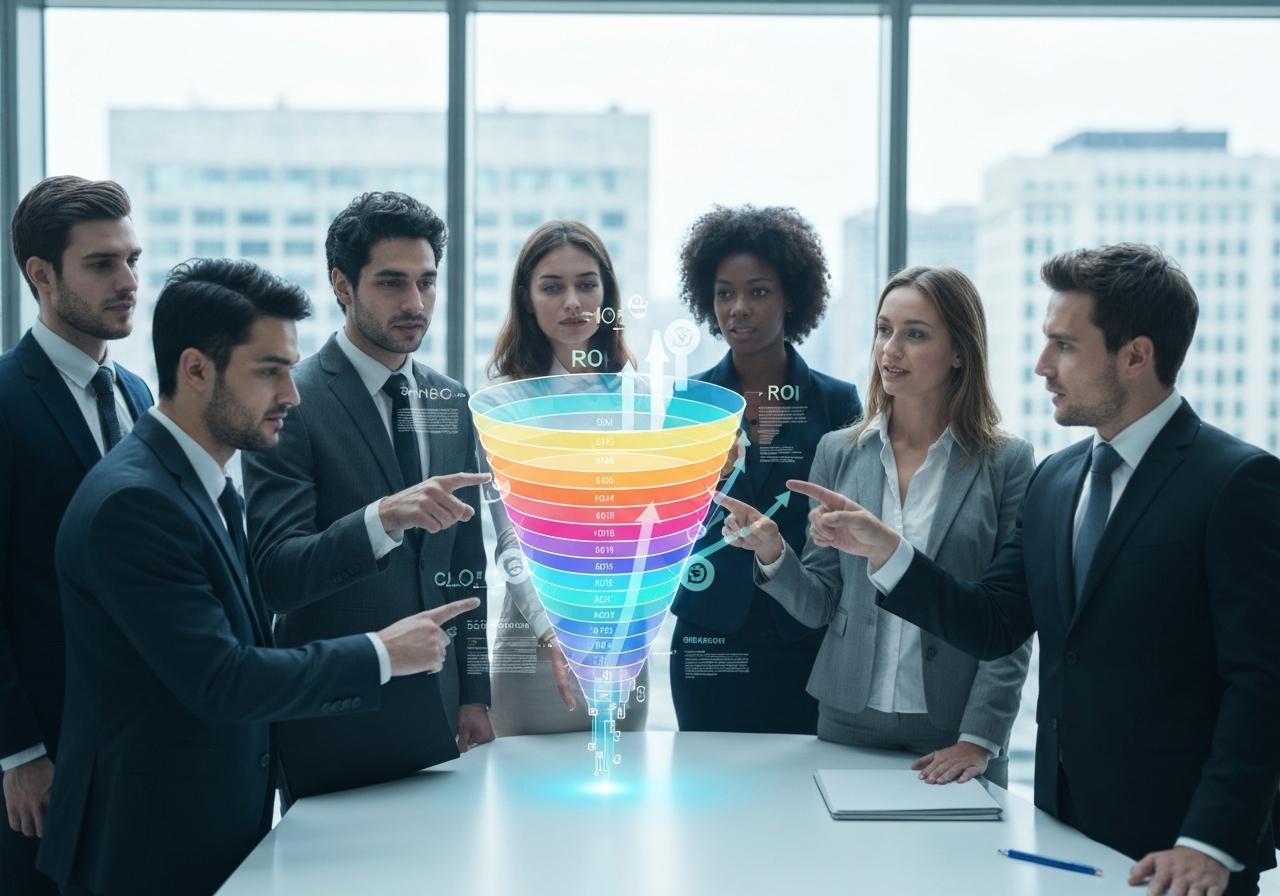

Are you struggling with an inconsistent lead flow and unpredictable revenue? A properly built and optimized marketing and sales funnel is the ultimate engine for sustainable business growth. This comprehensive guide provides a step-by-step blueprint to not only construct a powerful funnel but also fine-tune it for maximum revenue, turning potential interest into loyal, high-value customers and creating a predictable sales pipeline.

Understanding the Modern Marketing and Sales Funnel: A Unified Engine for Growth
The modern customer’s path to purchase is no longer a straight line. It’s a complex journey across multiple touchpoints. A unified marketing and sales funnel acts as your roadmap, guiding potential customers from their first point of awareness to becoming loyal advocates for your brand, ensuring a seamless and positive experience.
What is a Marketing and Sales Funnel and Why is it Crucial for Revenue?
A marketing and sales funnel is a strategic model that visualizes the customer journey, from the initial moment they become aware of your brand to the point of purchase and beyond. It’s crucial because it provides a clear framework for understanding your audience’s needs at each stage, allowing you to deliver the right message at the right time. This targeted approach directly impacts revenue maximization by improving lead quality and increasing conversion rates.
Marketing Funnel vs. Sales Funnel: Two Halves of a Single Customer Journey
While often used interchangeably, the marketing funnel and sales funnel have distinct roles. The marketing funnel focuses on the top of the journey—generating awareness, capturing interest, and nurturing leads. Its goal is to create Marketing Qualified Leads (MQLs). The sales funnel takes over from there, focusing on converting those MQLs into Sales Qualified Leads (SQLs) and ultimately, paying customers. They are not separate entities but two critical, interconnected halves of the complete buyer’s journey.
The Key Stages Explained: From Awareness to Loyalty (TOFU, MOFU, BOFU)
Understanding the different stages is fundamental to building an effective funnel strategy. These stages are often categorized as Top of the Funnel (TOFU), Middle of the Funnel (MOFU), and Bottom of the Funnel (BOFU).
- Awareness Stage (TOFU): At the top, your audience has a problem and is searching for answers. The goal here is to attract a wide audience with valuable, educational content like blog posts, social media updates, and infographics. This is about generating broad awareness for your brand as a solution provider.
- Interest & Consideration Stage (MOFU): In the middle, prospects are aware of your brand and are actively considering their options. Here, you need to build trust and demonstrate expertise. Effective content includes in-depth guides, webinars, case studies, and email marketing campaigns designed to nurture leads.
- Decision & Action Stage (BOFU): At the bottom, leads are ready to make a purchase decision. The focus shifts to conversion. Content like product demonstrations, free trials, customer testimonials, and detailed pricing pages helps convince them that your solution is the best choice. This is where you present a clear call to action (CTA).
- Loyalty Stage: The funnel doesn’t end at the sale. This post-purchase stage is about retaining customers and turning them into brand advocates. Excellent customer service, loyalty programs, and exclusive content are key to increasing customer lifetime value (CLV/LTV).
How to Build Your High-Performance Marketing and Sales Funnel Step-by-Step

Constructing a funnel requires a systematic, customer-centric approach. At LIEN MMO, we guide our partners through a structured process to ensure no potential revenue is left on the table.
Step 1: Map the Customer Journey and Define Your Ideal Buyer Persona
Before you build anything, you must understand who you’re building it for. A detailed buyer persona—a semi-fictional representation of your ideal customer—is essential. What are their pain points? What goals are they trying to achieve? Where do they look for information? Answering these questions allows you to map the customer journey and align your funnel stages with their specific needs and behaviors.
Step 2: Create Compelling Content for Each Funnel Stage (Lead Magnets, Webinars, Case Studies)
Content is the fuel for your funnel. Your content marketing efforts must be tailored to each specific stage to effectively guide prospects through their journey.
- TOFU Content: Create valuable lead magnets like free eBooks, checklists, or templates to capture contact information.
- MOFU Content: Host webinars or publish detailed case studies that showcase your expertise and the results you deliver.
- BOFU Content: Offer free consultations, product demonstrations, or compelling customer testimonials to close the deal.
Step 3: Drive Traffic and Generate Leads with a Multi-Channel Strategy (SEO, Social Media, Email Marketing)
Once your content is ready, you need to drive traffic to it. A multi-channel digital marketing approach is most effective. Leverage SEO to capture organic search traffic, use social media marketing to engage with your audience where they are most active, and implement targeted paid ad campaigns to reach specific segments. This integrated strategy ensures a steady flow of new prospects into the top of your funnel for effective lead generation.
Step 4: Nurture Leads and Qualify Prospects (From MQL to SQL)
Not every lead is ready to buy immediately. Lead nurturing is the process of building relationships with prospects through targeted communication, typically via email marketing campaigns. By providing consistent value, you can guide them through the consideration stage. This process also involves scoring leads based on their engagement and demographic data to identify when a Marketing Qualified Lead (MQL) is ready to be passed to the sales team as a Sales Qualified Lead (SQL).
Supercharge Your Funnel: Advanced Optimization Techniques for Maximum Revenue

Building a funnel is just the beginning. Continuous optimization is where you unlock its true revenue-generating potential. This involves analyzing data, identifying weaknesses, and systematically improving performance.
Identify and Fix Leaks by Tracking Key Performance Indicators (KPIs)
Your funnel will inevitably have “leaks”—points where prospects drop off. By tracking the right Key Performance Indicators (KPIs), you can pinpoint these weaknesses. Essential metrics include conversion rates between stages, customer acquisition cost (CAC), and customer lifetime value (CLV). Analyzing these numbers will show you exactly where to focus your optimization efforts for the greatest impact on business growth.
Proven Sales Funnel Optimization Techniques to Increase Conversion Rates (A/B Testing, Refining CTAs)
Conversion rate optimization (CRO) is a critical discipline for maximizing funnel performance. One of the most effective methods is A/B testing, where you compare two versions of a webpage, email, or CTA to see which one performs better. Consistently testing elements like headlines, button colors, and offer copy can lead to significant lifts in your conversion rates. Refining your CTAs to be more specific and compelling is another powerful tactic.
Leveraging CRM and Marketing Automation to Enhance the Customer Experience
Modern technology is a game-changer for funnel management. A Customer Relationship Management (CRM) system provides a central database for all customer interactions, giving your sales and marketing teams a unified view of each prospect. When combined with marketing automation platforms, you can scale your lead nurturing and personalization efforts, ensuring a seamless and responsive user experience (UX) without manual intervention.
B2B vs. B2C: Tailoring Your Funnel Strategy for Different Audiences
The core principles of a marketing and sales funnel apply to both B2B and B2C businesses, but the execution differs. The B2B marketing funnel often involves a longer sales cycle, multiple decision-makers, and a greater emphasis on relationship-building and educational content. In contrast, B2C funnels are typically shorter, more emotionally driven, and focused on creating a smooth, frictionless path to purchase.
Real-World Success: Marketing and Sales Funnel Examples that Convert
Theory is one thing, but seeing funnels in action provides clarity. Here are two examples illustrating how these strategies apply in different contexts.
B2B Funnel Example: A SaaS Company’s Journey from Demo Request to Loyal Client
A SaaS company targeting marketing managers wants to generate leads for its project management tool.
- TOFU: They publish SEO-optimized blog posts on “project management tips” and promote them on LinkedIn, driving traffic to a landing page with a free “Productivity Checklist” lead magnet.
- MOFU: Leads who download the checklist receive an automated email sequence inviting them to a webinar on “How to Streamline Your Marketing Workflow.” This webinar demonstrates the challenges their tool solves.
- BOFU: Webinar attendees receive a targeted offer for a personalized one-on-one demo. After the demo, the sales team follows up to close the deal. The entire process from lead to SQL is tracked in their sales pipeline management system.
B2C Funnel Example: An E-commerce Brand’s Strategy to Reduce Cart Abandonment and Boost CLV
An online store selling handmade leather goods wants to increase sales.
- TOFU: They run engaging Instagram and Facebook ad campaigns showcasing their products in lifestyle settings, driving traffic to their product pages.
- MOFU: They use retargeting ads to show specific products to users who previously viewed them. They also capture emails with a “10% off your first order” pop-up.
- BOFU: If a user abandons their cart, they automatically receive a sequence of emails: the first is a simple reminder, the second might offer a small discount, and the third creates a sense of urgency. This strategy directly targets a major leak in the e-commerce funnel.
A well-structured marketing and sales funnel is more than a theoretical model; it’s a dynamic and predictable process for driving growth. By systematically building each stage, creating value-driven content, and continuously optimizing based on data, you transform your business operations into a powerful, revenue-generating machine. At LIEN MMO, we’ve seen firsthand how this strategic approach fosters lasting customer relationships and ensures long-term success.
Ready to build your own revenue-generating machine? Download our free Customer Journey Mapping Template to start building your high-conversion funnel today!